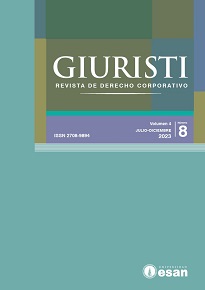
Jurisprudential analysis of the introduction of enemy criminal law in economic crimes
DOI:
https://doi.org/10.46631/Giuristi.2023.v4n8.10Keywords:
Presumption of innocence, lesivity principle, need for criminal sanction, money laundering, illegal minery, corruptionAbstract
The objective of this research is to identify how Peruvian courts of justice use elements of the enemy's criminal law to resolve economic crimes. Consequently, the conclusions of this article will demonstrate how the classic principles of the citizen's criminal law, such as minimal intervention, harmfulness, and the presumption of innocence, are limited in economic crimes through the criminal law of the enemy.
The article has social significance because it addresses the justice request ed by economic agents, users and consumers to achieve the basic conditions of citizen security in which they can develop their economic activities
Downloads
References
Arbeláez Herrera, Ángela M. «La noción de seguridad en Thomas Hobbes». Revista Facultad de Derecho y Ciencias Políticas 39, n.° 110 (enero-junio, 2009): 97-124. https://www.redalyc.org/pdf/1514/151412842005.pdf
Corrupt Practices Investigation Bureau. «Definition of Corruption [Definición de corrupción]». CPIB. https://www.cpib.gov.sg/about-corruption/preventionaand-education/definition-of-corruption/
Fetscher, Iring. «Filosofía moral y política en J. J. Rousseau». Traducido por Ramón García Cotarelo. Revista de estudios políticos, n.° 8 (1979): 7-32. https://dialnet.unirioja.es/servlet/articulo?codigo=1273183
García Palominos, Gonzalo. «Equivalentes funcionales en los delitos económicos. Una aproximación de solución ante la falta de lesividad material en delitos de presentación de información falsa al mercado de valores». Política criminal 12, n.° 23 (2017): 151-206, http://dx.doi.org/10.4067/S0718-33992017000100006
Independent Commission Against Corruption. «Jiàgòu [Arquitectura]». ICAC, 30 de setiembre de 2022. https://www.icac.org.hk/tc/about/struct/index.html (consultado el 6 de octubre de 2023).
Jakobs, Günther y Manuel Cancio Meliá. Derecho penal del enemigo. Madrid: Thomson Civitas, 2003.
John Locke, Lewis Frederick Abbott e Industrial Systems Research. Two Treatises on Government: A Translation into Modern English [Dos tratados sobre gobierno: una traducción al inglés moderno]. Manchester: Industrial Systems Research, 2013.
Mamani Gutierrez, Elani Yahaira. «La negociación incompatible no es un delito de peligro concreto, sino abstracto (Suprema se aparta de la Casación 841-2015, Ayacucho) [Casación 1765-2019, Lima]». Pasión por el Derecho, 28 de abril de 2022. https://lpderecho.pe/delito-negociacion-incompatible-peligro-abstracto-oconcreto-casacion-1765-2019-lima/
Pacheco Rojas, Diana Liseth. «Momento consumativo de la colusión simple [Casación 1648-2019, Moquegua]». Pasión por el Derecho, 23 de febrero de 2023. https://lpderecho.pe/momento-consumativo-colusion-simple-casacion-1648-2019
moquegua/
Pérez González, Sergio. «Racionalidad penal-económica y sistemas de cumplimiento como derecho intermedio». Revista Electrónica de Ciencia Penal y Criminología 2019, (2018). http://criminet.ugr.es/recpc/20/recpc20-19.pdf (consultado el 6 de octubre de 2023).
Silva Sánchez, Jesús María. Aproximación al Derecho penal contemporáneo. 2.a ed., Montevideo-Buenos Aires: B de F, 2010.
Torres Negrón, Alejandro. «Prueba suficiente para condenar por delito de lavado de activos [R.N. 2780-2017, Lima]». Pasión por el derecho, 21 de setiembre de 2018. https://lpderecho.pe/prueba-suficiente-condenar-lavado-activos-2780-2017lima/
Sala Penal Permanente. Casación n.° 2097-2019, Lima. «La carga de la prueba en el delito de enriquecimiento ilícito». PDF. 21 de setiembre de 2021. https://img.lpderecho.pe/wp-content/uploads/2021/11/Casacion-2097-2019-Lima-LPDerecho.pdf?_gl=1*z8rk8d*_ga*MTI5MTkwMzEyMS4xNjk5OTMwODMz*_ga_CQZX6GD3LM*MTcwMDI2MzQ0NS43LjEuMTcwMDI2Mzc0NS42MC4wLjA
Sala Penal Transitoria, Casación n.° 464-2016, Pasco. «El delito de minería ilegal y el informe administrativo». PDF. 21 de mayo de 2019. https://www.gacetajuridica.com.pe/boletin-nvnet/ar-web/Cas.464-2016-Pasco.pdf
Published
How to Cite
Issue
Section
License
Copyright (c) 2024 Omar Ahomed

This work is licensed under a Creative Commons Attribution 4.0 International License.
All content in the electronic journal is distributed under a license for use and distributionCreative Commons Attribution 4.0 International (CC BY 4.0). By which:
You are free to:
- Share — copy and redistribute the material in any medium or format for any purpose, even commercially.
- Fit — to remix, transform, and build upon the material for any purpose, including commercially.
The licensor cannot revoke these freedoms as long as you follow the terms of the license.
Under the following terms:
- Attribution— You must give credit appropriately, provide a link to the license, and Please indicate if any changes have been made You may do so in any reasonable manner, but not in any way that suggests the licensor endorses you or your use.
- There are no additional restrictions.— You cannot apply legal terms nor technological measures that legally restrict others from making any use permitted by the license.
Copyright
The authors retain their copyright. Therefore:
- The authors retain their intellectual property rights: copyright, trademarks and patents, as well as any process or procedure described in the article.
- The authors retain the right to share, copy, distribute, perform and publicly communicate the article published inGiuristi: Revista de Derecho Corporativo (Giuristi: Journal of Corporate Law) (for example, placing it in an institutional repository or publishing it in a book), with acknowledgment of its initial publication inGiuristi: Revista de Derecho Corporativo (Giuristi: Journal of Corporate Law) .
- The authors retain the right to republish their work, to use the article or any part thereof (for example: a compilation of their works, lecture notes, a thesis, or a book), provided they acknowledge its initial publication in theGiuristi: Revista de Derecho Corporativo (Giuristi: Journal of Corporate Law) (authors of the study, name of the journal, volume, number and date).